At 11 p.m. a delivery rider crouches by the roadside, scrolling through thirty funny short videos in five minutes, some with only a glance, and then he gets up and continues his route. Some articles think that in dark times, creating and appreciating beauty is a universal form of human resilience. But if beauty is truly that universally accessible, why does that rider choose short-video dopamine over a visit to an art museum?
This matters because we are living in an era where “spiritual comfort” is being aggressively commercialized and discursively packaged. For that delivery rider, what is truly the problem is not that he doesn’t have the ability to “discover beauty” but his lack of time to stop and discover anything at all. If we ignore this gap, then we are risking dressing up class privilege as the whole world’s human wisdom, leaving those who are truly squeezed without even a proper name to. describe for their exhaustion. Consider the evidence from everyday life around us.
Let’s take a cleaning lady as an example, a woman in her fifties who leaves home at 6 a.m. and come back at 9 p.m.; she always juggling four households a day. Her only entertainment is a app on her phone which is a match-three puzzle game; she said: “When I’m too tired to think, I just clear a few levels and let my brain go blank.” According to the “China Survey on the Quality of Life 2022-2023,” the average leisuretime for Chinese people on a workday is only 2.7 hours. During this limited leisure time, only 18.81% of urban residents spend their time on cultural activities such as visiting a museum or some art galleries. The majority of their disposable time is consumed by dailylife work, only a very small percentage of people will use this time to visit art galleries and exhibitions, especially poeples with a monthly income of less than 8,000 yuan the percentage is likely even lower. This all suggests an uncomfortable truth: the state of “art as a healing tool” looks less like a universal human need and more like cultural capital circulating among those who already have it; the educated ones use art to soothe themselves and then write to tell everyone else this is “the path for all humanity.”
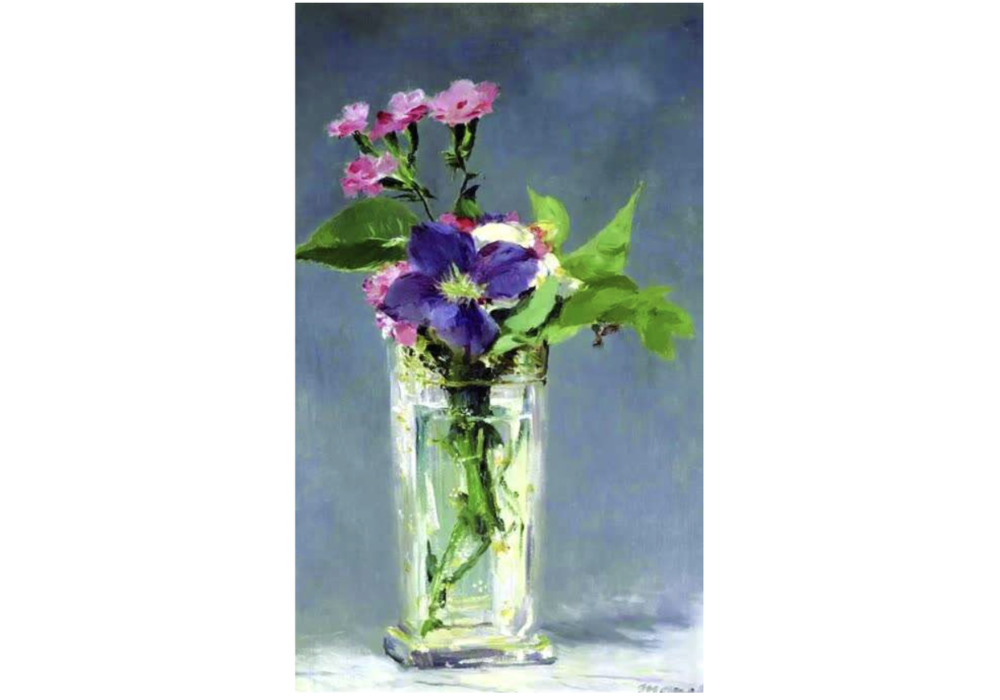
Manet’s last drawing “Carnations and Clematis in a Crystal Vase”
Critics might argue that I am reducing spiritual life to economic determinism. They would give examples such as some great artists who produced masterpieces that show their pain and what they had suffered before, like Van Gogh in poverty and Serebriakova after losing her husband, who is still painting. They would state that beauty has the special power to cure others, it doesn’t require a high income or formal education. Beauty only needs you to have a sensitive heart. To be fair, it’s true that they are correct. Art’s emotional resonance is not entirely determined by the conditions aitists are facing; some artist do draw real comfort from a flower or a song in their darkest moments.
However, this argument falls short because it uses exceptional historically cases to cover the silent majority who never found such solace. It overlooks a deeper truth: generating art from suffering and receiving healing from art are two entirely different mechanisms. The former is the creator’s active expression; the latter is the receiver’s passive nourishment, and passive nourishment requires prerequisites, including enough stability to remain open. The cleaning lady is not “insensitive”; her sensitivity has simply been occupied by the noise of survival, leaving no bandwidth for a painting. Her experience shows that the question has never been “does art work, ” but rather “for whom does it work.”
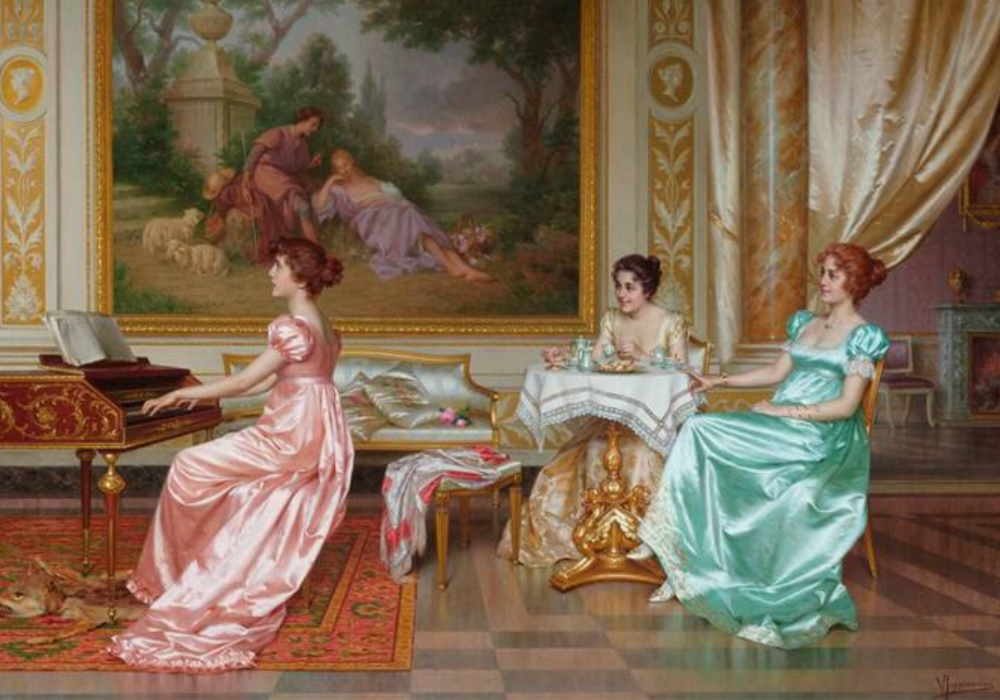
Regianini’s “Concert”
Essentially, the point of “art as a healing” isn’t really something that discusses art but is actually focusing on how we should allocate the small, unused portion of our remaining spiritual energy? We must stop assuming that art and beauty are free, readily available, and inexhaustible resources. The truth is quite the opposite: appreciating beauty requires conditions, and these conditions are unevenly distributed. Before discussing “beauty in the dark,” we need to consider whether there is light, time, or a chair to sit down and catch our breath in the darkness. Art isn’t necessarily a privilege, but if we first assume it has never been a privilege, then it always will be.If it’s correct that turning to beauty and art during dark times is a form of universal human resilience, then why does it seem in reality that this “resilience” is most readily attained and imbued with meaning by those whose lives are already secure enough to afford it, while those mired in deeper adversity often tend to numb themselves with cheap dopamine rather than seek solace in a painting?