Phenomenon: 36 Applications, Two Licences — Both with Banking DNA
On 10 April 2026, the Hong Kong Monetary Authority (HKMA) announced that it had granted the first stablecoin issuer licences under the Stablecoins Ordinance, with the licences taking effect immediately. By the application deadline of 30 September 2025, the HKMA had received submissions from 36 entities — a field that included tech and crypto heavyweights such as Ant Group, JD Coinlink, and Circle. Ultimately, licences were awarded to only two: The Hongkong and Shanghai Banking Corporation Limited (HSBC), and Anchorpoint Financial Limited, a joint venture of Standard Chartered Bank (Hong Kong), HKT, and Animoca Brands. As the HKMA highlighted, both licensed issuers bring deep expertise in traditional finance and risk management, and both are actively involved in the HKMA’s pilot projects on central bank digital currencies (CBDCs) and tokenised deposits.
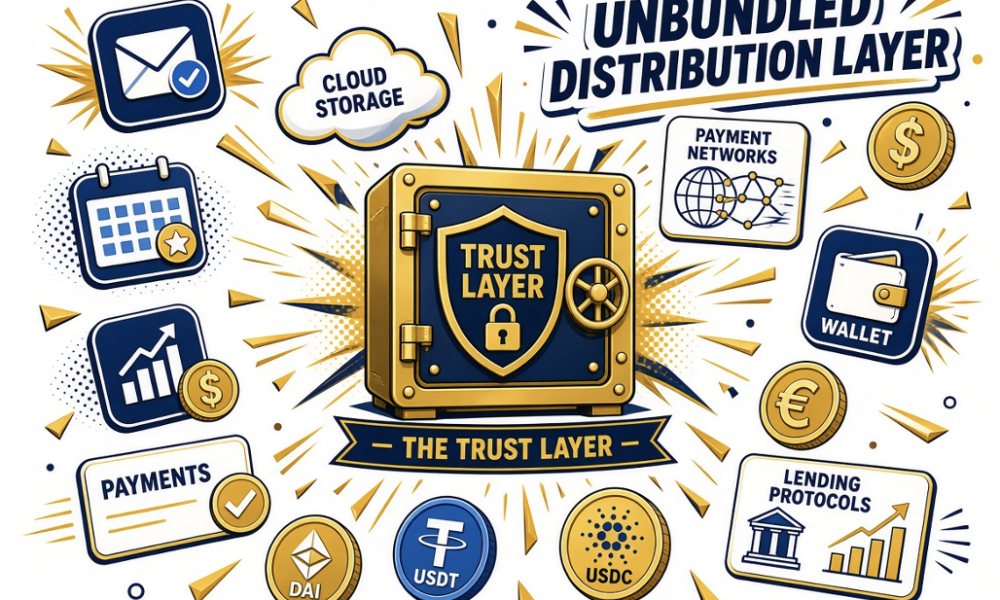
The contrast with the prevailing narrative is striking. For the past two years, the fashionable story has been that banks are being unbundled — the functions once bound together inside a banking licence pried apart and carried off one by one. Neobanks took the customer relationship (Revolut counts 68.3 million users). Wise and the card networks took the payment rails (Visa runs a net margin of roughly 50 percent — and it is not a bank). Stablecoins carried the dollar itself out of the banking system (USDT’s market capitalisation stands at roughly $184 billion as of mid-2026). And on-chain self-custody wallets are now attempting the final step: handing ownership of the account back to the individual. Four migrations of power, each cutting deeper than the last — first the experience, then the rails, then the money, and finally ownership itself. So when regulators handed out the first licences for “money on-chain,” why did every licence go to a bank?
Essence: The Distribution Layer Migrated; the Trust Layer Stayed
The unbundling narrative counted everything that left, but nothing that could not. The Bank for International Settlements’ 2025 annual report provides the diagnostic: sound money must pass a three‑part test — singleness (every unit exchangeable at par, at any time), elasticity (the capacity to expand and contract the money supply through credit creation), and integrity (resistance to financial crime). The BIS judged stablecoins to fail on all three counts.
The most persuasive exhibit is the Silicon Valley Bank episode of 2023. With $3.3 billion of Circle’s reserves parked at SVB, USDC broke its peg and fell to $0.87. It recovered only after the US Treasury, the Federal Reserve, and the FDIC jointly invoked the “systemic risk exception” and backstopped every deposit at the failed bank. The lesson: when a bank collapses, what rides to the rescue is the financial safety net — and banks are, for now, the only licensed access points to that net. The net is not merely a bank’s reputation; it is a sovereign backstop built into the bottom of the balance sheet — the lender‑of‑last‑resort mechanism and deposit insurance, codified in statutes from the Federal Reserve Act and the Federal Deposit Insurance Act to Hong Kong’s Banking Ordinance and Deposit Protection Scheme Ordinance, together forming an institutional firewall. A stablecoin protocol can copy the code. It cannot copy the reserved seat beside the central bank’s printing press.
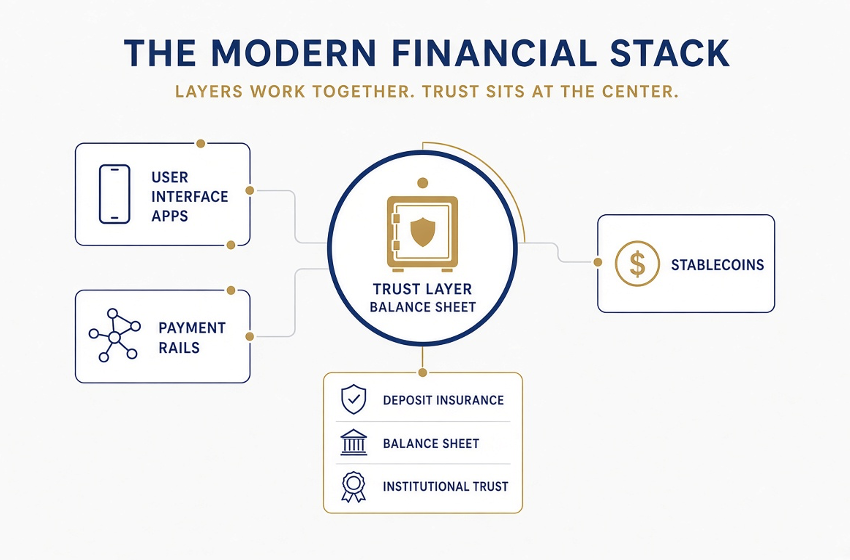
What the four migrations carried away, then, was the distribution layer — interfaces, experience, payment rails. The trust layer — licensed access, credit creation, deposit insurance, compliance infrastructure — remains firmly in bank hands. And whoever replicates those capabilities outside the system will find themselves regulated as a bank: the working logic of regulators’ own principle of “same activity, same risks, same regulation.”
Figure | The Modern Financial Stack: Distribution Layer vs Trust Layer
Core Overview: Stablecoins vs. Tokenised Deposits
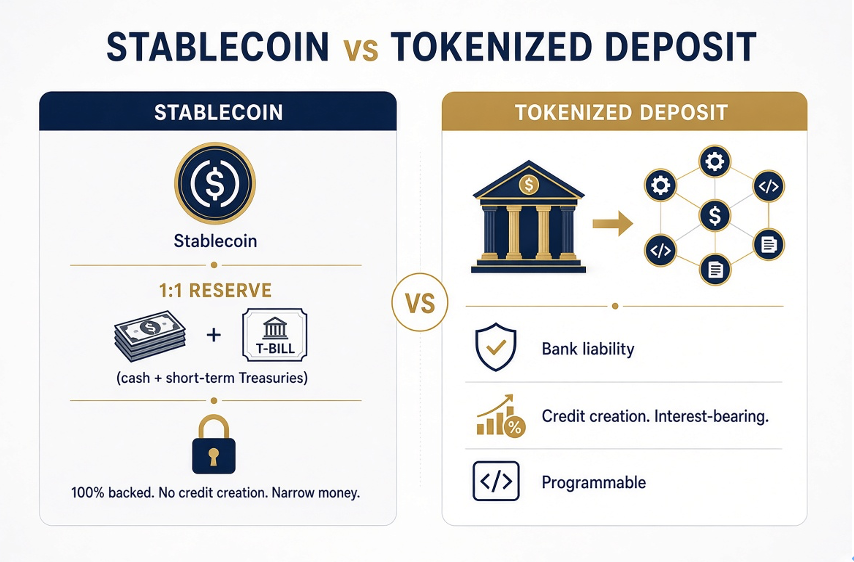
A stablecoin is fully reserved “narrow money”: for every token issued, the issuer must hold one unit of cash or short-term Treasuries in high-liquidity form, ready for redemption at any moment. Because reserves cannot be lent out, stablecoins can only move existing money around — they cannot create credit. A tokenised deposit — in the HKMA’s framing, a digital representation of commercial bank deposits — is, by contrast, the direct digitisation of a deposit liability already sitting on a bank’s balance sheet: it keeps deposit insurance, keeps credit creation, can pay interest — and gains the full technological dividend of programmability and 24/7 atomic settlement. JPMorgan’s deposit token, JPMD, went live for institutional clients on the public blockchain Base in November 2025; JPMorgan, Bank of America, Citigroup, and Wells Fargo — the four largest US commercial banks — together with more than a dozen other institutions, plan to launch a joint tokenised-deposit network in the first half of 2027 through The Clearing House, the settlement utility they jointly own. Tokenised deposits are the only play that captures the new technology without surrendering the old moat.
Figure | Stablecoin vs Tokenised Deposit
Strategic Perspective: My View on the “Unbundling of Banks”
The unbundling is real, and it is irreversible — but the conclusion has been drawn backwards. The real question is not whether banks have a seat at the table; it is whether they can hold it. Three judgments:
1) The trust layer’s seat belongs to the licence, not to whoever happens to hold one today. Circle is applying for a US trust bank charter; Revolut has long held a European banking licence. New entrants need not route around regulation — they can walk in the front door, fully licensed. Banks won the start, but a head start is not tenure.
2) Three detours to avoid. First, don’t try to beat neobanks on UX. That’s their religion; for you, it’s hygiene—essential to avoid losing customers, but no one crosses town for a spotless restroom. Second, don’t build a “super app.” You don’t have a social network’s zero-marginal-cost traffic, and your customers don’t want to bank where they scroll. Third, don’t wait for regulators to save you. The GENIUS Act and Hong Kong’s Stablecoins Ordinance aren’t shields—they’re on-ramps. Treat regulation as your moat, and you’ll wake up to find freshly licensed rivals swimming in it.
3) All monetisation of trust ultimately books as “fee income” — but the margins differ wildly. All monetisation of trust ultimately books as fee income — yet margins diverge sharply. Custody, fiat on/off ramps, and compliance-as-a-service are thin-margin pipeline businesses: thousands of licensed banks offer them, and competition will compress fees to commodity levels. Fat margins accrue only to those that secure standard-setting seats in the next generation of clearing — founding members of settlement networks, participant banks in central bank tokenisation pilots — which capture network effects and pricing power once the standard locks in. Visa’s profitability flows from network position, not from regulatory status. Pipelines keep you alive; standard-setting seats tell you what you’re worth.
Implementation Guide: Four Routes for Monetising the Trust Layer
| Route | What it means in practice | Reference cases | Economics |
| BaaS (Banking-as-a-Service) / embedded finance | Export the licence, accounts, and risk controls as a package; turn neobanks into distribution channels; never let the chain of accountability break | Chime’s deposits and clearing run entirely through partner banks; cautionary tale: the 2024 Synapse bankruptcy froze some $265 million belonging to more than 100,000 end users | Pipeline fee income — thin margins, fast volume |
| Tokenised deposits | Join clearing consortia and central bank pilots early; ensure the core banking system is “plug-in ready” | JPMD; The Clearing House joint network; HKMA Project Ensemble (EnsembleTX) | Standard-setting seat — fat margins, pricing power |
| Trust aggregation layer | Provide reserve custody, fiat on/off ramps, and institutional settlement for stablecoins | BNY Mellon custodies USDC reserves; ZA Bank became Hong Kong’s first stablecoin reserve custodian bank | Pipeline fee income, with a neutrality premium |
| Compliance-as-a-service | Package KYC and anti-money-laundering capability as APIs and sell them externally | Hard, non-discretionary demand wherever stablecoin regulation takes effect | Pipeline fee income; doubles as an ecosystem hook |
Action Recommendations by Bank Type
- Global systemically important banks (G-SIBs): Go all-in on tokenised deposits, because that is where pricing power lives. It is the only path to sustained dominance in tomorrow’s wholesale settlement market. Missing the standard-setting rounds at EnsembleTX and The Clearing House would mean ceding the role of SWIFT’s successor to someone else.
- Regional and retail banks: The standard-setting table has a clearing-volume minimum, and smaller institutions should not force their way to it. Their decisive ground is pipeline business — BaaS embedded finance and the trust aggregation layer (custody, on/off ramps) — supplying the licensed foundational services that stablecoin issuers, wallet providers, and fintechs have no choice but to use. Per-transaction profit is thin, but demand is inelastic, cash flow is steady, and the licence requirement keeps unlicensed competitors out.
- Hong Kong’s virtual banks: Freedom from legacy baggage makes compliance-as-a-service the natural differentiator. Take the exacting anti-money-laundering and risk workflows honed under HKMA supervision and package them into plug-and-play paid APIs — on-chain address risk scoring, real-time suspicious-transaction monitoring, automated regulatory reporting — sold to Southeast Asian exchanges and payment firms that lack both the compliance technology and bank-grade trust. What clients are buying is not just data; it is the legal accountability that a licensed bank carries. The compliance department is thereby transformed from a cost centre into a high-margin, high-stickiness business.
Implications for Hong Kong and the Mainland
Hong Kong is the clearest litmus test for the trust layer’s commercial viability. Beyond the licensing verdict, Project Ensemble entered its pilot phase — EnsembleTX — in November 2025, moving from sandbox experimentation to real-value transactions in tokenised deposits and digital assets. Interbank settlement of tokenised deposit transactions is initially facilitated via the HKD Real Time Gross Settlement (RTGS) system, and the participating banks occupy precisely the seats at which next‑generation clearing standards will be written. Membership in Project mBridge, the multi‑CBDC platform for cross‑border payments, is the entry ticket for cross‑border clearing. HSBC’s strategy is especially worth studying: it plans to embed its HKD‑denominated stablecoin directly into PayMe, a payment platform that already counts millions of users.
On the mainland, the policy pivot came in stages. Through the 2010s, Alipay and WeChat Pay took the retail interface from banks. In 2018, the “direct‑connection cutoff” pulled clearing authority back into public infrastructure. By the pilot years of the digital yuan (e‑CNY), banks appeared reduced to agents that merely exchanged and distributed it. Then, on 1 January 2026, the People’s Bank of China (PBOC) issued the Action Plan for Further Strengthening the Digital RMB Management and Service System and Related Financial Infrastructure, rewriting the script. The e‑CNY was recast from a cash‑like instrument into digital deposit money — “Digital RMB 2.0,” as commentators quickly dubbed it. Balances in commercial bank wallets are now bank deposit liabilities: interest‑bearing under prevailing deposit rate regulations, protected by deposit insurance, and integrated into banks’ asset‑liability management. In effect, China has used state power to enshrine tokenised deposits as the designated settlement vehicle. The e‑CNY sits on banks’ own ledgers; banks are once again principals that hold and deploy money, not agents issuing it on the central bank’s behalf. The seat is granted by the system, but the profit must still be earned — the digital yuan wallet is the new front line of interbank deposit competition.
Two markets point to a single conclusion: in strongly regulated systems, the endpoint of any migration of power is drawn by the regulator — and regulators keep reserving the trust layer’s seats for licensed banks. The risk for banks was never whether they would have a seat. It is that they win the seat but fail to hold it.
Conclusion: The bank will shed its skin
Technically, none of the routes above lies beyond a bank’s capability. Organisationally, each cuts against institutional inertia: BaaS means treating yesterday’s rival as today’s biggest client; tokenised deposits means turning IT from cost centre into main theatre; compliance-as-a-service means productising internal procedure for external consumption. The window will not close because technology passes you by. It will close on the day the Circles of the world receive their licences—and the banks are still reorganising their internal reporting lines.
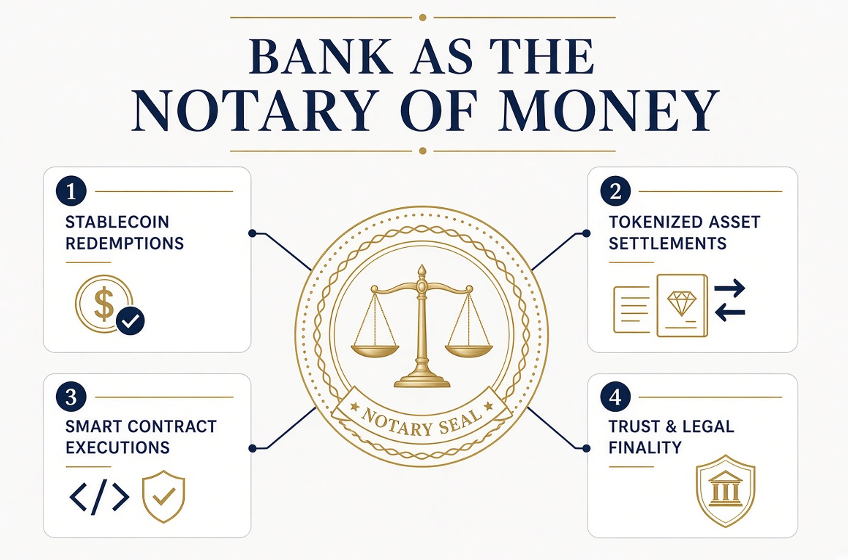
The bank of the future will not disappear. It will shed its skin. No longer a place that stores cash, it will become the digital economy’s settlement notary: the party that guarantees stablecoins redeem, on-chain assets clear, and smart contracts execute with judicial finality.
The endgame of this great migration is not the unbundling of banks. It is banks unbundling and reassembling themselves—heavy core systems into lightweight APIs, closed ecosystems into open marketplaces, and the compliance department, long treated as a burden, into the most profitable trust engine of all.
When anyone can issue money, a bank’s ultimate mission narrows to one: to become money’s notary and executor—certifying what is real, and settling what is owed.
When anyone can issue money, the bank’s ultimate mission is to become money’s notary and executor.
Figure | Bank as the Notary of Money
Data and Case Sources
Data and cases in this article draw on: the HKMA press release “Granting of stablecoin issuer licences” and the inSight article by Chief Executive Eddie Yue (both 10 April 2026); the HKMA press release announcing EnsembleTX, the pilot phase of Project Ensemble (13 November 2025); the BIS Annual Economic Reports for 2025 and 2026; the US GENIUS Act (S.1582); JPMorgan’s official JPMD press releases (June and November 2025); the joint announcement by The Clearing House and participating banks of the tokenised-deposit network (5 June 2026); the People’s Bank of China’s Action Plan on strengthening the e-CNY management and service system and related financial infrastructure (effective 1 January 2026) and the interest-bearing e-CNY announcements of the six large state-owned banks; Circle’s IPO prospectus; Visa’s FY2025 annual report; Revolut’s operating disclosures; the PBOC’s “direct-connection cutoff” notice (Yin Zhi Fu [2017] No. 209); stablecoin market-capitalisation data as of July 2026.